How leading experience strategy across Visa's client onboarding ecosystem moved it from a collection of disconnected products to a single, coherent journey, and shifted the organization around it.
The product clients interact with throughout onboarding. It shows them where they are in the process and what comes next, whether that's completing a product information form, submitting a license request, or waiting for Visa to review a step before they can move on.
The tool Visa's team uses to direct the process from the inside, reviewing submitted forms and data, validating entries, tracking where each client stands, and deciding what happens next before the client can proceed.
Clients moved through multiple products and teams, each with its own ownership model, priorities, and level of visibility into the whole. The problem looked, at first, like a product problem. It wasn't. It was a journey problem, and no single team owned the journey.
My contribution wasn't owning every decision, it was creating the shared direction that allowed dozens of decisions to move toward one experience.
Created and protected the end-to-end onboarding experience across client and operational journeys.
Defined the experience principles that guided product decisions, even under delivery pressure.
Built shared direction across product, engineering, research and operations, without formal authority.
Empowered the wider design team to own detailed design and execution once strategic direction was established.
This wasn't a linear project plan so much as a widening lens: from one product, to the whole journey, to the organization around it.
Rather than starting with screens, the work started by mapping the end to end journey: how product, operations, and implementation teams actually interacted with clients, and where the friction, redundancies, and ownership gaps lived. A pattern emerged: the same client was routed through different experiences and ownership models depending on where they stood in the onboarding lifecycle.
Journey mapping · Stakeholder workshopsThe vision: one onboarding experience instead of several disconnected ones. Clear ownership through the client lifecycle. Consistent patterns across products. Better visibility for clients. Less duplicated effort across teams. This reframed the question from "how do we improve a single product?" to "how do we improve onboarding as a whole?"
Experience vision · Journey frameworkI established the client-facing journey as the entry point into onboarding while creating a mirrored operational view for Visa teams. More importantly, I aligned product, engineering, research and content around a shared experience direction that multiple teams could scale.
Cross functional design leadershipWith the guided journey established, the work extended to closing the gap where onboarding had historically ended and lifecycle management began, the point where clients had to navigate a separate set of tasks like license requests with little continuity from what came before. This shifted surrounding conversations from product centric to lifecycle centric.
Lifecycle strategyNone of this held without alignment, and someone had to actually drive it. A significant share of the value here came from leading better decisions across teams: running workshops, negotiating competing priorities, translating customer insight into action, and holding stakeholders accountable to how their piece connected to the larger journey.
Workshop facilitation · Cross team alignmentA persistent question underneath the whole ecosystem effort: could different products actually follow the same stage by stage onboarding journey, or were they too different? Answering it required mapping each product individually, then overlaying them to test the hypothesis. The answer was yes, with a precise understanding of where and why divergence was unavoidable.
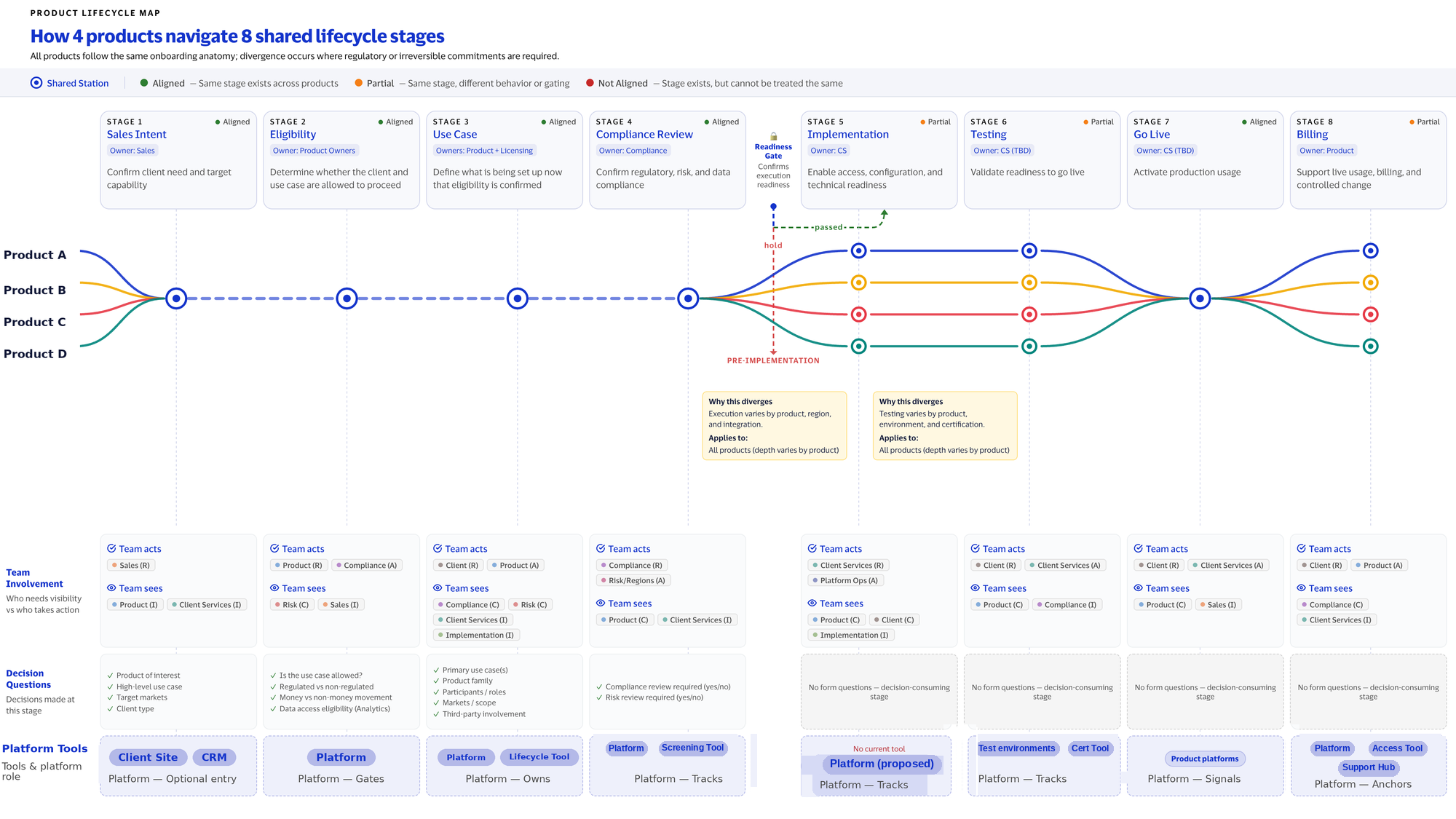
All four products share the same eight stage anatomy. Divergence only occurs at two points, Implementation and Testing, where regulatory requirements, environment setup, or irreversible commitments force product specific paths.
A shared structure meant onboarding could be governed, tracked, and experienced as one journey. Without this proof, every product team could argue for its own model, preventing any coherent client experience.
A single governance model for onboarding stage ownership. A shared language for status, decisions, and team responsibilities across all four products. And, critically, a foundation that made one connected client facing experience possible, because it proved the underlying structure already existed.
These KPIs were designed to measure whether the experience was actually reducing friction for clients, not just whether features shipped. Each group addresses a specific business problem and tracks whether the design solved it.
These KPIs were designed to measure whether the experience was reducing friction, not just whether features were built. Each metric has a direct line back to a client problem and a business outcome.
Impact across three groups, because a journey problem only gets solved when the business, the client, and the team move together.
I had the opportunity to collaborate with her on the Visa Launchpad design, and I was consistently impressed by her insightfulness and strong customer first mindset. She has a unique ability to bring concepts to life in ways that keep client needs at the center of every decision.
If I ran this again, I'd push for a shared onboarding ownership model earlier in the process, rather than building alignment initiative by initiative. Getting the vision right was necessary but not sufficient. The harder, slower work was getting operations and implementation teams into the room before the future state direction was already drafted, not after. Alignment is cheaper before a vision exists than after people feel it's being handed to them. It's a pattern I've carried into how I approach every cross team effort since.
My contribution wasn't designing a better onboarding flow. It was helping the organization think about onboarding as one connected experience.
Understand the ecosystem before proposing solutions.
Bring business objectives and customer needs into the same conversation.
Build shared ownership across product, ops, and implementation.
Create structures that outlive a single product or release.
Use design to shift how teams work together, not only how a screen looks.
The result: a more aligned organization and a clearer path for clients to reach their goals.